How to Write a Check in 6 Steps (With Examples)
Need to print a check? Fill one in with our free check writer — pick a template, add your details and download a print-ready PDF. No signup.
Key Takeaways
- •A check has six fields — date, payee, numeric amount, written amount, memo, and signature
- •The written amount in words is the legally binding amount if there's a discrepancy
- •Always use ink, never pencil, and draw a line after the payee name and written amount
- •The memo field is optional but useful for your own records
- •You can use an online check writer to fill in and print checks without ordering a checkbook
Writing a check is a straightforward process once you know what each field is for. This guide walks through every part of a check, in order, so you can fill one out correctly the first time.
What Are the Parts of a Check?
Before filling anything in, it helps to know what you're looking at. A standard US check has these sections:
| Field | Where it is | What it's for |
|---|---|---|
| Date | Top right | When the check is written |
| Pay to the Order of | Middle left | Who receives the money |
| Amount box ($) | Right side | Dollar amount in numbers |
| Amount line | Middle | Dollar amount written in words |
| Memo | Bottom left | Optional note for your records |
| Signature | Bottom right | Your authorization |
| Routing number | Bottom left | Identifies your bank |
| Account number | Bottom center | Identifies your account |
| Check number | Bottom right / top right | Sequential number for tracking |
How to Write a Check: Step by Step
Step 1 — Write the Date
In the top right corner, write today's date in MM/DD/YYYY format. For example: 04/12/2026.
You can also post-date a check by writing a future date if you want the recipient to wait before depositing it — though banks are not legally required to honor this.
Step 2 — Write the Payee Name
On the "Pay to the Order of" line, write the full name of the person or business you're paying. Be specific:
- For a person: John Smith (not just "John")
- For a business: Acme Plumbing LLC (use the exact business name)
After writing the name, draw a line through any remaining blank space to prevent someone from adding another name.
Step 3 — Write the Amount in Numbers
In the small box to the right (usually marked with a $ sign), write the dollar amount in numbers. For example:
1,250.00
Include cents even if the amount is a round number — write 500.00 not just 500.
Step 4 — Write the Amount in Words
On the long line below the payee name, write the dollar amount in words. This is the most important field on the check — if there's a discrepancy between the number and the words, the written amount in words is the one banks use legally.
Examples:
- $1,250.00 → One Thousand Two Hundred Fifty and 00/100 Dollars
- $500.00 → Five Hundred and 00/100 Dollars
- $87.45 → Eighty-Seven and 45/100 Dollars
The cents are always written as a fraction over 100. After writing the amount, draw a line through the remaining blank space to prevent alterations.
Step 5 — Add a Memo (Optional)
The memo line in the bottom left is optional, but useful. Write a brief note about what the check is for:
- January rent
- Invoice #1042
- Birthday gift
This helps both you and the recipient keep records, and can be useful if a dispute arises later.
Step 6 — Sign the Check
Sign your name on the signature line in the bottom right corner. Use the same signature your bank has on file. A check without a signature is invalid — the bank will not process it.
Completed Check Example
Here's what a correctly filled-out check looks like:
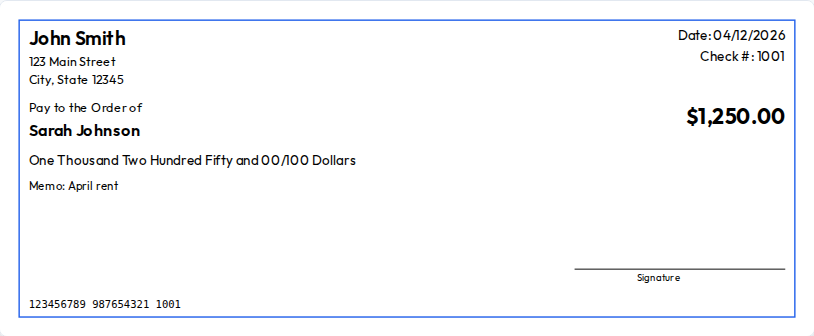
| Field | Example value |
|---|---|
| Date | 04/12/2026 |
| Pay to the Order of | Sarah Johnson |
| Amount ($) | 1,250.00 |
| Amount in words | One Thousand Two Hundred Fifty and 00/100 Dollars |
| Memo | April rent |
| Signature | Your signature |
Common Mistakes to Avoid
Using pencil — Always use a pen with permanent ink. Pencil can be erased and the check altered.
Leaving blank spaces — Draw a line through unused space after the payee name and written amount to prevent fraud.
Writing the wrong amount in words — Double-check that the written amount matches the number. If they differ, the bank uses the written words.
Forgetting to sign — An unsigned check is invalid. Banks will return it unpaid.
Post-dating without telling the recipient — While you can post-date a check, banks may cash it early. If timing matters, notify the recipient and confirm they'll wait.
Using the wrong account — If you have multiple bank accounts, double-check the routing and account numbers at the bottom of the check match the account you intend to draw from.
How to Write the Amount in Words: More Examples
This is the part most people find confusing. Here are more examples:
| Number | Written form |
|---|---|
| $25.00 | Twenty-Five and 00/100 Dollars |
| $100.00 | One Hundred and 00/100 Dollars |
| $350.75 | Three Hundred Fifty and 75/100 Dollars |
| $1,000.00 | One Thousand and 00/100 Dollars |
| $4,275.50 | Four Thousand Two Hundred Seventy-Five and 50/100 Dollars |
Note: compound numbers between 21 and 99 use a hyphen — Twenty-Five, Forty-Three, Seventy-Eight.
What If You Make a Mistake?
If you make an error while filling out a check, write VOID in large letters across the entire check and start over with a new one. Do not try to cross out or correct a mistake — banks may reject altered checks.
Keep voided checks rather than throwing them away, as they can be used to set up direct deposit or automatic payments.
Using an Online Check Writer
If you write checks regularly — for payroll, rent, vendor payments, or contractors — an online check writer lets you fill in the details digitally and print a professional check on blank check stock. This is faster than handwriting, easier to keep records, and produces a cleaner result.
CheckWriter lets you create checks in minutes with no signup required. Choose from personal, business, payroll, or bank-specific templates, fill in the fields, and download as a PDF for printing.
Create a check now →
Browse check templates →
Frequently Asked Questions
What happens if the number and words don't match on a check?
The written amount in words takes legal precedence. Banks are trained to use the words if there's a discrepancy. Always double-check both fields match before signing.
Can I write a check to myself?
Yes. Write your own name on the "Pay to the Order of" line. This is commonly done to transfer money between accounts or to withdraw cash at your bank.
How long is a check valid?
Most personal checks are valid for 180 days (6 months) from the date written. After that, a bank may refuse to honor it, though some will still process it. Business checks often have shorter validity periods printed on them.
Can I write a check if I don't have a checkbook?
Yes. You can use an online check writer to create and print checks on blank check stock paper. You don't need a pre-printed checkbook — just your routing number and account number, which are on your bank statement or in your online banking app.
What is the memo line on a check for?
The memo line is optional and has no effect on the payment. It's purely for record-keeping — a note to yourself or the recipient about what the payment is for.